Sunday, 5 October 2014

The Popes of Wessex - Thomas Hardy writes...


Following the title page, the book bore an inscription:

“If you do not place something of your family history on record it is sometimes invented for you, and it generally does you less justice than you would do yourself.”

These were the days before the mass interest in the family histories of non-aristocratic or royal personages, before Who Do You Think You Are and Ancestry.co.uk and searchable online census returns.  Many families, mine included, did not consider their lives worthy of documenting; something I have noticed even to this day, in my interviews of inspirational veterans of the Second World War who lived through remarkable times.

The book's foreword was written by poet and author Thomas Hardy, the name many people associate with Dorset and a family friend of the Popes. For me as a cultural historian, the final sentence reaffirms my passion for uncovering, discovering and publicising the stories of individuals in the extraordinary circumstances which twentieth-century warfare brought about.

The sturdy Dorset family of the Popes, a section of which has been grouped together for memorizing in the following volume, needs no apology for a modest appearance in a privately printed record based upon the varied achievements of one household, so to speak, in the present war – a household which has been for many years among my nearest neighbours.

Upon the family names it is not necessary to dilate.  It has been known hereabouts – in Stalbridge, Marnhull, Corscombe, the Tollers and, late, Chilfrome – for centuries; and it may be mentioned that when John White went from Dorchester, England, to found Dorchester, Mass, U.S.A., he took with him some Dorchester Popes, whose descendants are now noteworthy people of Massachusetts.  That research might be able to trace consanguinity between the Dorset Popes and the poet Alexander has often been a conjecture of the present writer, based purely on the poet’s interest in at least one corner of the county – Sherborne and its vicinity – of which, as is well known, he gives a long description in a letter to Miss Blount.

The circumstances of the great conflict which, we many at least hope, is hastening to a close, differ so largely from those of the previous wars of this country, that it is impossible to infer how many, or even if any more than had already done so, of the eleven brethren here marshalled would have deliberately chosen a military or naval career in ordinary conditions.  Yet to read over their actions at this point of time conveys a fancy that they would all have fallen into line naturally:

Though war nor no known quarrel were in question;
                                                            …assembled and collected
As were a war in expectation.

However that may be, these chronicles, even when they become musty with age, may be interesting not only to descendants of the family but to others who are not of their blood or name.  It often has happened that an account of what befell particular individuals in unusual circumstances has conveyed a more vivid picture of those circumstances than a comprehensive view of them has been able to raise.

                                                                                                                                                      T.H.

September 1918


A Wessex Family in the Great War - The Popes of Wrackleford House, Dorset


Forthcoming blog posts will be about the remarkable Great War story of the Pope family of Wrackleford House, near Dorchester.

My interest was first stirred in the Popes during an early August tour of the churches to the north of Dorchester, most of which remain delightfully open and welcoming.  Outside the church at Stratton, I noted that the war memorial contained the names of three Popes, a fact which struck me as I had been researching, on behalf of the Bible Society, the theme of siblings during the war, already having studied the Bickersteths of Leeds, the Beecheys of Lincolnshire and the Souls of Gloucestershire. In fact the Popes made up thirty percent of the names listed:-

LIEUT-COL. E. ALEXANDER POPE. D.S.O. THE WELSH REGT.
LIEUT-COL. A. R. HAIGH-BROWN. D.S.O. THE MIDDLESEX REGT.
CAPTAIN C. A. W. POPE. R.A.M. CORPS.
2ND LIEUT. PERCY P. POPE. THE WELSH REGT.
LANCE CORPL. R. F. GIFFORD. 21st BATT. CANADIAN INFANTRY.
LANCE CORPL. ERNEST BRETT. ROYAL IRISH RIFLES.
GUNNER A. C. BELL. R.G.A.
PRIVATE ARTHUR GODDEN. THE DORSET REGT.
PRIVATE. H. C. AMOR. 1ST BATT. DORSET REGT.
DRIVER. S. O. BRIEN. R.F.A.


On entering the church there were plaques commemorating the three Popes, and to other members of the same family.  Intrigued, I was determined to find out more.  However the first privilege was to attend a candlelit vigil in the church in commemoration of centenary of the outbreak of the Great War on 4th August 2014.  I felt a connection to the past, and of the continuity of the soul of England in that place.
St. Mary's Church, Stratton, Dorset with War Memorial in the foregound
 

A search on the internet revealed that the Pope family had had a book privately published in 1919, with biographies and pictures of many members of the family who had served in the war.  However one difficulty was that only two copies of the book existed in the United Kingdom which were available for public viewing and study; one at the University of Cambridge Library, and the other at the Library of the Honourable Society of the Inner Temple in London.  No copy seemed to exist in any other domestic archive.  Undeterred, I did locate a copy available to purchase from a private dealer in Canada and the deal was struck.

The book safely made the return journey across the Atlantic to the country in which it had been published by the Chiswick Press, and as I read the pages written with care and love by R.G. Bartelot, a member of the family, my pulse quickened as the story on one family’s enormous war sacrifice unfolded. No fewer than seventeen sons, daughters and in-laws had served in the Empire's cause between 1914 and 1918.

As this information is not widely available in the United Kingdom, I am going to make the story of the Pope family the topic of the next series of blog posts; or, in the words of the book, to reveal the service of:

A WESSEX FAMILY AND THE GREAT WAR


Saturday, 14 June 2014

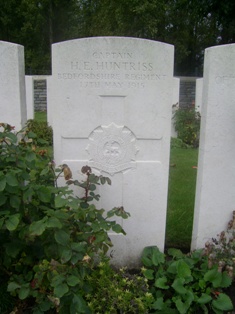
Huntriss Memorial Window: Mattersey, Nottinghamshire

One memorial window which takes the breath away is situated on the south wall of the parish church in Mattersey, Nottinghamshire.  The church is one of the majority which thankfully is open during daylight hours.  In fact, given the fact that the Church of England is a major custodian of the nation's heritage as the official state church, I think it is beholden on them to open all churches unless there is a compelling reason not to.  But that is a topic for another day.

The window commemorates the deaths of three brothers who spent some of their youth in the quiet village.  They were the sons of William and Charlotte Huntriss.  William had married Charlotte in 1883 and was a successful farmer who by 1911 was living at Mattersey Hall.  He died in 1912 before the war broke out.  Charlotte was thirteen years younger than her husband and would live until 1939.


The quote above the figures is from Revelation 2:10 and reads:
 
BE THOU FAITHFUL UNTO DEATH AND I WILL GIVE THEE A CROWN OF LIFE
 
Underneath the tableau is the inscription:
 
IN EVER LOVING MEMORY OF LIEUT WILLIAM HUNTRISS, 3RD DUKE OF WELLINGTON'S WEST RIDING REGIMENT (ATTACHED TO GOLD COAST REGIMENT) BORN DECEMBER 16TH 1886; DIED OCTOBER 23RD 1918 AT COOMASSIE, AFRICA.
CAPT. HAROLD EDWARDS HUNTRISS, 1ST BATTALION BEDFORDSHIRE REGIMENT, BORN MAY 23RD 1890; DOED OF WOUNDS AT FESTUBERT, FRANCE MAY 17TH 1915.
CAPT. CYRIL JOHN HUNTRISS, 1ST BATTALION EAST YORKSHIRE REGIMENT. BORN JANUARY 23RD 1893, KILLED AT FRICOURT, FRANCE JULY 1ST 1916.


Cyril was born in Scarborough and educated at Uppingham School. He had served in France since January 1915. Cyril had won the Military Cross for conspicuous gallantry on 9th August 1915.  At Hooge, Belgium, he had, `led four bombing parties up to the assault on the enemy's position with the greatest coolness and daring.'  He had also been mentioned in despatches by Field Marshal Sir John French in January 1916.   He was killed on the first day of the Battle of the Somme in 1916, along with nearly 20,000 other British troops.  His body was never found and he is commemorated on the Thiepval memorial.

Harold was born in East Markham, Nottinghamshire.  The following information comes from the website www.bedfordregiment.org.uk :


Captain Harold Edward HUNTRISS

Killed in action 17th May 1915, aged 24

Harold was born 23rd May 1890 in East Markham, Nottinghamshire, the son of William Huntriss, J.P. and Charlotte Elizabeth Huntriss. He was educated at Uppingham between 1904 and 1908, after which Harold applied to the Sandhurst Royal Military Academy on 29 September 1908, giving his address as Mattersey Hall, Bawtry, Yorkshire.

He was promoted to Lieutenant on 3rd May 1911 and arrived with the 2nd Battalion in France 6th October 1914. Lieutenant Huntriss was hit by shrapnel in the left thigh on the 29th or 30th October, during intense fighting east of Ypres and returned to England to recover after an operation.

Harold returned to the 2nd Battalion in April or May 1915 but was killed at the head of his Company as they advanced to the second German trench line, Major MacKenzie and Lieutenant Hutton-Williams being killed close by. All three were buried together despite the difficulties their men had recovering their bodies after the battle.

At the time of his death, he lived at Harlsen House, Belvedere Road in Scarborough, his widowed mother being his next of kin (resident at 116 Wheelwright Road, Gravelly Hill in Birmingham). There also seems to be a link to Huntriss and Huntriss Solicitors in Halifax who handled his mother's affairs, his brother William seemingly being a partner within the firm.

Lieutenant Huntriss is buried in the Guards Cemetery, Windy Corner, Cuinchy, 7km east of Bethune..


William was born in Scarborough and died on the Gold Coast (now Ghana) and died in 1918, a few weeks before the end of the war.


Their names also appear along with the others from the village who made the ultimate sacrifice on the marble tablet next to the window.


One final twist to the tale was that when I came to sign the church visitors' book, the last entry was for a Brian Huntriss from Leicestershire.  I wonder if he is a relation.  I think an enquiry letter beckons.

Wednesday, 11 June 2014

The Way Ahead

I have been researching the men and women of faith in both World Wars for the past eight years.  In that time I have clocked up thousands of driving miles, spent nearly £8,000 in course fees and hundreds of pounds on books.  All this has been self-funded whilst working full-time in education.

In order to finish the project and submit a PhD thesis which can then be turned into a book and perhaps more I need a further £8,000 for university fees and further funding to travel to interview the dwindling band of WW2 veterans to record for posterity their stories of faith in wartime.  My supervisor has told me that this is valuable and ground-breaking work and there's definitely a book (or two!) in there. 

If anyone is able to contribute any sum, please get in touch (johnbroom@aol.com).  Or if anyone would like to invest into a share of any future publication royalties I would love to discuss it.

Anonymous donations can be made to Halifax acc: Sort code 111271, Account number 00095755

Saturday, 7 June 2014

David Briggs - Conscientious Objector who braved the D-Day beaches

Whilst driving to work on Friday, I was listening to the D-Day commemorations on Radio 4.  One feature which greatly moved me was an interview with David Briggs.  He mentioned being in the RAMC, which interested me as that was where my own father, about whom I have posted elsewhere on this blog, did his WW2 service.  Then it transpired that David Briggs was in that regiment because of his Christian convictions, leading him to conclude that he could not bear arms and kill a fellow human.

I did some internet research and discovered that as well as being a fine example of Christianity leading and sustaining peoples' actions in wartime, he had appeared on the first Christmas Carol Service broadcast on radio in 1928 and had gone on to become an eminent headmaster at Kings' School, Cambridge.

His interview is a must-hear for anyone interested in the connection between war and religion in the twentieth century.  Below is a picture of him being interviewed, and one taken at Cambridge a few years ago.  The interview can be heard here:-

http://audioboo.fm/boos/2229577-conscientious-objector-david-briggs-on-d-day


Wednesday, 4 June 2014

Army Chaplain Training for D-Day, 1944

The following information is drawn from Alan Robinson's excellent book, Chaplains at War: The Role of Clergymen during World War II (London: I.B. Tauris, 2008)

Chaplains taking part in the D-Day landings and action in Europe beyond that began to receive special training for their tasks.

By 1944 concerns had grown about the amount of army chaplains being killed in action, many through taking unneccesary risks to tend to their men.  An earlier order to leave wounded men on the battlefield if the chaplain himself was in danger had proved unhelpful, so in early 1944 a training course was established to prepare chaplains for D-Day and beyond.

Rev. I.D. Neill, Senior Chaplain to the 43rd Division, organised a five day course for his chaplains which included vehicle maintenance, cooking, radio communication, avoiding mines and booby traps, camouflage, security, first aid, map reading and night marches.  It was then decided that all chaplains who were to take part in the Normandy landings should undergo similar training.

Rev. Ivan Neill


The battle school for chaplains was established at Church Stowe in Northamptonshire.  Around two hundred chaplains of all denominations, including Catholics, undertook the course in February and March of 1944.  Additional topics included mine lifting, digging slit trenches, identifying battle sounds to distinguish between rounds passing close by and the general noise of battle, a night navigation exercise, evacuating wounded soldiers and a rigorous assault course.  The assault course included crawling under barbed wire with machine guns firing overhead, jumping into a stream and crawling along trenches.

Unfortunately one chaplain, Rev. Geoffrey L. Treglown, was blinded and had his hand blown off when he used his helmet to smother a stick of explosive that fell in front of him.

Any chaplain failing the course would be posted to bases and lines of communication rather than the front line.

Chaplains attached to the Parachute Regiment received specialised training.  Major-General Browning, commander of the 1st Airborne Division obtained permission from the War Office to put his chaplains through the same training as his officers and men.  Chaplains who joined the Parachute Regiment were all volunteers and motivated by a sense of adventure and a wish to test themselves.  It was a sure way of experiencing combat.  The parachutists spent two weeks training at Hardwicke in Derbyshire.  They had to complete runs of up to 10 miles, assault courses and gym training.  One chaplain, the Rev. Goode was said to be good at `smiting his opponents in the boxing ring in a most unclerical and unbrotherly fashion.'  They also had to pass interviews with psychiatrists to see if they were mentally robust enough for parachute operations.  If they passed the training course and interviews they were sent to RAF Ringway near Manchester for specific parachute training.

Rev Bernard Egan, one of the few Catholic chaplains to complete airborne training wrote:

There was no doubt that the position of a parachute chaplain made all the difference to his relations with the men.  He could truly say that he was one of them, and the men, for their part, liked to feel that the chaplain was undergoing the same trials as themselves, and their mutual feelings of discomfort, nervousness, and exhilaration, were equally shared.  Personal relations with the men mean so much to a chaplain that he feels, these having been so well established, that the difficulties he is likely to encounter have been more than halved.


Rev. Bernard Egan

Sunday, 1 June 2014

Alistair Urquhart - Worship in Captivity

The most stunning book I have read in a long time is Alistair Urquhart's The Forgotten Highlander.  He cheated death so many times and displayed such mental strength for three and a half years that it is amazing that he is still alive today, aged 94.  He survivied the Death Railway, the Hell Ships and the dropping of the atomic bomb on Nagasaki.

This is a passage he wrote about a concert followed by an impromptu church service at Changi camp in 1942, before the worst of the treatment kicked in:-


One evening hundreds of men milled about our normal spot up the hill.  There was to be a concert, a break from the grinding monotony of camp life.  As a music lover I was thrilled.  The boys were excited too.  Somehow, goodness only knows how, a piano had been dragged all the way up the hill.  It was a brilliant moonlit night and as the musicians arranged themselves total and respectful silence descended on the huge crowd.  Had it not been for the sound of the crickets and the tropical breeze, we could have been in the Albert Hall.  Then a solo violinist, a professional with the London Philharmonic called Dennis East, stepped forward and the plaintive notes of Mendelssohn’s Violin Concerto reverberated around the hillside.  It was the first music we had heard for months.  I sat entranced, and the boys, strangers to classical music, were agog – spellbound by Mendelssohn’s magic.  For a few minutes the beauty of the music lifted us out of the camp and reminded us of the greatness of European civilisation that Japanese militarists despised.  Some men wept.  When East finished several stunned seconds passed before rapturous applause and cheering broke out.  It was so beautiful.

Eventually the Japanese guards present got bored and left.  When they ahd gone an altar was set up and an interdenominational church service was held.  It proved a welcome morale booster.  Even people like me, not especially religious, found it comforting.  It was to be my one and only church service during three and a half years of captivity but it struck a real chord and made me think seriously about Christianity for the first time.  When the padre finished his sermon on our mount in Changi prison, thousands of miles from home, hundreds of voices joined in a moving rendition of `The Old Rugged Cross.’

The first verse seemed so appropriate to all of us caught up in the fall of Singapore:

On a hill far away stood an old rugged cross,
The emblem of suffering and shame:
And I love that old cross where the dearest and best
For a world of lost sinners was slain.

The Brinds (two teenagers who Urquhart looked after in his first months in captivity) were both devout Roman Catholics.  Freddie never talked about his beliefs but the brothers were always missing on Sunday mornings and were friendly with the Roman Catholic padre.  The Japanese did not allow church activities yet there were obviously secret masses going on – at considerable risk to all involved.  I never enquired because I did not want the boys to think I was spying on them.  Freddie always wore a crucifix on a silver chain, which he kept tucked under his shirt. If the guards had discovered it, they would have taken it from him and given him a beating.